EuroBusinessMedia (EBM): AXA, a world leader in insurance and asset management, reports results for 2014. Henri de Castries, welcome.You are the Chairman and CEO of AXA, to begin, what are your comments on the 2014 results?
Henri de Castries: They are pretty strong results, 2014 has been a very strong year for the group, revenue wise and earnings wise. Revenue wise the business has been growing in all segments; Life business, where the new business is up; Property & Casualty where we are growing in nearly all of our geographies and Asset Management where we have significant positive inflows for both AXA Investment Managers and AllianceBernstein. Earnings wise, the picture is also a pretty nice one, because we are reaching the highest level ever of underlying earnings for the group and the net income is up in the double digits. This is a satisfactory situation for the group in an environment which has not been benign. We have had our share of natural catastrophes. We have also seen a significant decrease in long-term interest rates and despite that, we have strong earnings. These strong earnings are allowing us to significantly increase the dividend paid to the shareholders. So a good year.
EBM: Are you on track to reach the targets that you had set for the Group at the end of 2015 under the Ambition AXA plan?
Henri de Castries: Yes, I think we are very much on track with what the long-term plan was. You have to remember that this plan started in 2010 and that the goal was to have underlying earnings progressing between 5 and 10% on average. We are there, and well there. The second thing that we were trying to achieve was to accelerate the growth in emerging countries. We’ve built further blocks on that way in 2014 by acquiring a very good business in Nigeria, by setting up an agreement with a good bank in Poland, as examples. We had decided to increase the efficiency of the group by reducing costs further and at the same time preparing the future through digital investments. We are there. We will have saved, at the end of the plan, probably more than €1.9 billion, so this is good. And the last part of the plan was selectivity in the business and if you look at the business mix it has evolved according to what our plans were, especially on the Life side. So overall, a satisfactory situation, well aligned with the full completion of Ambition AXA.
EBM: How do you see the future for the Group?
Henri de Castries: Beyond Ambition AXA, we will have, of course, to come up with a new strategic plan, but we are looking at the long term. We think that there is good news and that there are some challenges. The good news is that the need for security, the need for coverage, the need for insurance protection is growing everywhere in the world. This is true in mature markets, this is true in emerging markets. So basically the demand addressed by the insurers will grow. And we will have to satisfy our customers in the coming years, in an environment where even if the macro picture is contrasted, the needs will be there. That’s good news. The way to satisfy the customers, nevertheless, is going to change. We will have to adapt the new technologies, we will have to satisfy more and more demanding customer needs and this is going to lead us to invest more in the technologies of the future. We are going to invest €950 million on the digital side in the coming years. We think it’s a necessity. We think that it’s a good thing for the group because it’s going to enable us to acquire new clients and to treat better the ones we already have.
EBM:Henri de Castries, Chairman & CEO of AXA, thank you very much.
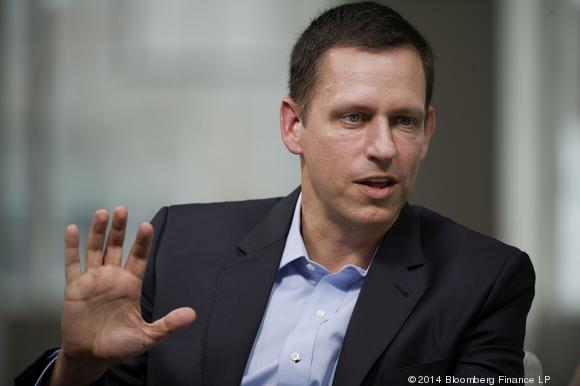
Peter Thiel spoke at Columbia Business School in New York City Wednesday night, about why entrepreneurs should try to establish monopolies and uncover secrets. It was the first book tour stop for the public on his new book, "Zero to One: Notes on Startups, or How to Build the Future."
Bloomberg/David Paul Morris
The UpTake: Peter Thiel doesn’t think like other entrepreneurs, and he wears the “contrarian” label with pride. But while the PayPal cofounder and venture capitalist’s genius cannot be cloned—at least not yet—he’s out with a new book to help you channel his thoughts on monopoly, secrets and market domination.
ForPeter Thiel, it clearly isn’t enough to have innovative ideas that lead to creating companies likePayPalandPalantir Technologies. He’s also given thought to how innovative business ideas come about, and these self-described “contrarian” ideas are laid out in his new bookZero to One: Notes on Startups or How to Build the Future.
Co-written withBlake Masters, the book is based upon his lectures in a class that he taught at his alma mater, Stanford University. (Insert irony here, because Thiel is the same entrepreneur who through his foundation encourages would-be college students to become Thiel fellows in his 20 under 20 program and start businesses instead.)
But last night marked the official book tour kickoff as he spoke to budding entrepreneurs atColumbia Business School, followed by a Q and A session with Columbia journalism school graduateShane Snow, a cofounder himself of the media startupContently.
Here are some of the highlights:
Don’t be a copycat:Part of knowing what type of business to go into is knowing which types to avoid. In Thiel’s estimation, business ventures in areas in which great ideas and innovations have already taken place are finished. “All of the great innovations in business and technology happen once,” Thiel said. That’s why the “next Mark Zuckerberg” for example won’t be building a social network. While Facebook built and dominated in social media, companies like Airbnb andeBaydid the same in their markets, so he says better to stay away. “I basically focus on the question of what great companies nobody has started,” Thiel says. He’s especially fond of people whose ideas sound crazy to most people, like those of hisPayPalcofounder Elon Musk who is determined to see humans live on Mars in his lifetime and has said that he personallywants to die on Mars, “just not on impact.”One of Thiel's favorite questions for entrepreneurs: “Tell me something that’s true that almost nobody agrees with you on.” As a “contrarian investor,” who started theFounders Fundin San Francisco, Thiel doesn’t want to pile onto the same company as other venture capital firms, but seeks out the markets that no one else is investing in. The classic example: he was an early investor in Facebook, which was ignored at the time by Boston VCs.
Win at monopoly:“The wisdom of the crowd” has some budding entrepreneurs moving into areas where the competition is steep, assuming that their idea will win and that capitalism and competition go hand in hand. Thiel says they do not. “The goal of every entrepreneur who starts a company is to create and build a new monopoly,” Thiel said. “If you want to have a successful company, you should have a monopoly.” The example he gives isGoogle, with its lock on search. “A company like Google is extremely capitalistic, and it’s had no real competition in search since it definitively distanced itself fromYahooandMicrosoft,” he said. While Google can also point to other businesses like its Android platform, self-driving cars, Google Glass and more, he suggests these are ways to make its core business and market seem more diverse and its company less a monopoly than it actually is. He suggests companies that are actually monopolies deny that they are, while companies that are not monopolies do the opposite, insisting that they have no competitors.
Small markets rule:While the above advice might sound like an indication to go after larger markets, Thiel says he likes to see startups go after smaller markets. Monopoly just means having the greatest market share in any given market. “Either have a technology advantage that’s big enough that people can’t copy it, or have some distribution plan that you scale rapidly,” Thiel said.
Pursue secrets:Thiel likens starting a business to discovering a secret, but to do so you have to believe that secrets still exist.“You have conventional things that everyone understands, mysteries that no one does, and secrets that people try to figure it out,” Thiel said. A common and disheartening mistake is to think “there are no secrets left, everything has been found.” Those who believe there are secrets are those “who will look for things to discover and will find them. And the people who don’t, wont’ even try. That’s at the core of what drives many of these startups.”
Work with friends or potential ones:Considered the “don” of the PayPal mafia, Thiel says that he and cofounder Max Levchin assembled a group of other co-founders who knew each other either from Stanford or the University of Illinois. Their idea was to create a company “where some incredibly strong friendships were formed.” They hired not necessarily only friends but people “we thought, we could be friends with.” The reason? To avoid the sort of cut-throat competitive atmosphere Thiel experienced when he worked for a New York law firm for less than a year. “One of the things I didn’t like was all the people around me were structurally hostile. Of the 80 people who came in, only five would make partner,” he recalled. “Way before the external competitors destroy you, it’s the internal people that don’t get along,” he says. By contrast the PayPal founding team, had “a good prehistory," plus an idea they had been "thinking about for a long time.”
Google’s Grand Plans: A Conversation With Larry Page and Sundar Pichai
Photo
Google's chief executive, Larry Page, with its head of Android, Sundar Pichai, left, at the company's annual developer conference on Wednesday.CreditJeff Chiu/Associated Press
Shortly after Google’s keynote presentation at the company’s developer conference on Wednesday, I was ushered into a green room backstage at the Moscone Center in San Francisco.
As workers broke down the huge conference stage around us — with the lights flickering on and off, somewhat apocalyptically — I spent a half hour talking to Larry Page, Google’s chief executive, and Sundar Pichai, Google’s senior vice president in charge of Android and Chrome. Sergey Brin, who founded Google with Mr. Page, popped in and out of the room but did not take part in the interview.
We chatted about Google’s efforts to usher in the multidevice future of computing, and the challenges it may face in that task. We also discussed how Google’s ambitions might alter its image.
I wrote a columnabout some of our discussion, but Mr. Page and Mr. Pichai made other comments that are also worth airing. Here is a fuller, though edited transcript of the discussion:
Q.
One of the themes here is that Android is going to be a platform for more than phones — you want to have it in multiple devices. What’s the long-term vision for how Google services will be in different devices?
A.
Mr. Page: That’s a very broad question. We’ve been talking about a multiscreen world for a long time. I think you see it culminating in something that’s a great experience across lots of different kinds of devices, from the watch to the TV to the laptop to the tablet to the phone.
But I think there’s much more to do. I think it’s exciting to see developers — if we’re reasonably clever and thoughtful about what we do, we can get experiences that make sense to users and are reasonably easy for developers to implement.
Q.
How useful is the multiscreen world now?
A.
Mr. Page: More and more of my time is on phones — though also it’s nice to use a big screen and have something plugged in. Some of the basic things we’ve done like Chrome tab synchronization and the ability to access your email across devices, we take those things for granted, but if you use them 100 times a day it’s a really important thing.
Mr. Pichai: I also think we are just at the beginning stages. Today, computing mainly automates things for you. But there’s an evolution from, today we tell computers to do stuff for us, to where computers can actually do stuff for us. For example, if I go and pick up my kids, it would be good for my car to be aware that my kids have entered the car and change the music to something that’s appropriate for them.
Q.
What are the hurdles in that path?
A.
Mr. Page: Like anything, it’s just work. It’s easier to talk about things than do them.
Q.
Do you worry that the more devices we have that are connected to Google, there’s not just a privacy question but also something like creepiness?
A.
Mr. Page: I think that the Internet and mobile devices in general is changing people’s lives a lot. And we’re feeling that. Everyone can tell that their lives are going to be affected, but we don’t quite know how yet, because we’re not using these things — and because of that there’s a lot of uncertainty. I think we’ll figure that out and we’ll get products, services and technologies that really benefit people a lot, and that make their lives significantly better. And as we do that people will understand those — and then there’ll be the next set of things.
Q.
You’re saying the usefulness of the products will change how people feel about them?
A.
Mr. Page: Yeah, and we know that if we talk about things before people see them, there’s a much more negative reaction. That’s one of the things we learned. It’s really important for people to be able to experience products; otherwise you fear the worst without seeing those benefits.
I’m not trying to minimize the issues. For me, I’m so excited about the possibilities to improve things for people, my worry would be the opposite. We get so worried about these things that we don’t get the benefits. I think that’s what’s happened in health care. We’ve decided, through regulation largely, that data is so locked up that it can’t be used to benefit people very well.
Right now we don’t data-mine health care data. If we did we’d probably save 100,000 lives next year. I’m very worried that the media and governments will try to stoke the people’s fears and we’ll end up in a state where we could benefit a lot of people but we’re not able to do that. That’s the likely outcome.
Q.
What can you do about that?
A.
Mr. Page: I think talking about it — being honest that these things are going to change people’s lives, these are major issues we should be talking about. But not trying to sensationalize it and figuring out how to have a good dialogue about the issues that are out there.
I would encourage people to have an open mind, and to look to the future with a sense of optimism.
Q.
You bought Nest and Dropcam recently. But you also sold Motorola. What are your thoughts on Google’s approach to building hardware?
A.
Mr. Pichai: When Larry and Sergey founded Google Search, one of the things that struck me is that it was available for everyone to use. We deeply desire our services to work for everyone. And that inherently means we have to work with partners. That is the thesis underlying everything we do.
Mr. Page: That’s why our services work on iOS.
Mr. Pichai: We do hardware when we think we need to guide the industry, which is why we do things like Nexus. Philosophically we’re deeply committed to working on an ecosystem at scale.
Q.
So where do Nest and Dropcam fit in?
A.
Mr. Page: Nest has a very strong team. I’ve had home control stuff since 10 years ago. I was installing various things and it never quite worked. It’s a nascent market. I think Nest is able to lead that ecosystem. At the early stages, that’s what you see.
Mr. Pichai: Nest is one vertical implementation of a set of smart products for the home. But we will support other people’s smart products for the home.
Q.
Was there some part of the Nest acquisition that was aimed at improving Google hardware generally — they’re good at hardware, and you need that expertise for other Google hardware?
A.
Mr. Page: A lot has been written about that, but I don’t think that’s the primary motivation. It was a pretty expensive company. They have a lot of product traction, which seemed important to us. The idea that we want to distract them from that doesn’t make a lot of sense.
What we got with Nest was a complete, functioning company and brand in an important, emerging area, that’s doing really well.
Q.
What’s going on with Google Plus?
A.
Mr. Page: I think there’s a lot of things going on with Google Plus. I’m a very excited user of it. You saw some demos showing how it works with Chromecast — that’s one of the things I’ve been excited about. The service has been growing tremendously. People are always like, “Oh, what’s going on?” But for us, we’re superexcited about it because it’s a big service, growing continuously, since we launched it, at a high rate, and we’re making it better and better every day.
Q.
Is “social” as important to you now as it was two years ago?
A.
Mr. Page: Yes, if anything, probably more important. We have a very excited, dedicated community. People forget we’re able to make our services better by understanding your relationships, making sharing work and understanding identity. These are deep and important things for us as a company.
When people ask about Google Plus they think about it as, “I’m going to the stream.” For us, Google Play reviews are part of Google Plus, too. We see all those things growing and being important for us.
Q.
I wanted to ask about the European “right-to-forget” ruling. What was your reaction to that?
A.
Mr. Page: “Right to be forgotten.” You can’t forget, but you can be forgotten. I think in general the issues about how you might be represented online when people search for you is an important issue. To date, we’ve said we’ll try our best to represent the things that are out there on the Internet about you. It’s worked for 15-plus years. It makes a lot of sense. We’re a search engine. It seems like we should represent what’s in the world.
So it was a pretty surprising ruling — it’s a different statement. You guys are now in charge of editing what’s out there in the world. In the past that’s not a responsibility we felt we had. I think given that’s the ruling, we’ve obviously said we’re going to start complying with that. We’re going to start removing some stuff pretty quickly — I think in the next week. We’re obviously going to try to do the best job we can.
I think it would have been better to have more of a discussion about what to do and how to do it. We could have arrived at a more practical place than a court ruling. The previous system, where content is removed at the source of publishing, means that once it’s removed there, it’s removed for all other services. Whereas with the ruling, it has to be removed from all services — so if you’re an aggrieved user, you have to get your information removed from many sites that have that data. That doesn’t seem very practical.
Q.
I want to return again to this idea of Google’s image. There were a couple of protests here. There have been protests about Google buses.
A.
Mr. Page: We’re in San Francisco, so we expect that.
Q.
Do you think it’s just that? One of the things that’s happening in the world is that people are worried about technology and how it’s changing our lives — is this a manifestation of that worry?
A.
Mr. Page: I’m sure that people are worried about that. I’m sure that’s contributing to it. But I do think there are serious issues in San Francisco. There’s a rich history of protest in San Francisco. I think some of the issues — we have complaints about some things that are not that related to the company. To some extent we’re being used as a way to attract attention. We had protests about the C.I.A. and I don’t know what else, but it didn’t make any sense to me with respect to the company. As a big company we’re a target for some of these things. But I think people have legitimate issues with it as well.
Mr. Pichai: We’re doing a lot about it as well. There are a host of initiatives for the city. I think in some ways it’s good that there’s an open debate about it and I think we needed it. There’s been a lot of growth and the area is trying to adapt to that growth and that has been a concern.
SuiteWorld 2014 Keynote — Cloud ERP: Your Unfair Advantage
Watch Zach Nelson, CEO of NetSuite, and special guests at SuiteWorld 2014 as he reveals the future of cloud computing and the big ideas that will enrich your customer relationships, revolutionize how you think of commerce and transform your overall business, giving you the edge you need to succeed in today’s dynamic world.
Oracle CEO and billionaire Larry Ellison is following in the footsteps of his children. He’s getting involved in the film business.
In this case, he’s launching a new politically minded film festival hosted on his Hawaiian Island, Lanai.
But he’s not just going to host a festival. He’s hoping to change the festival industry altogether.
The inauguralLanai Documentary Film Festivalwill take place February, 2016, on the subject of “Governance for Africa.” It will showcase films on things like women’s rights, education, animal welfare, sustainable living and technology.
Unlike other festivals that screen films in the hopes of getting a bigger distribution deal, Ellison’s crew plans to use social media and other tech to turn these films into year round events, it says.
The crew will pick films far in advance and select filmmakers for fellowships. It will then follow the filmmakers all year and show the film in 2016 like a grande finale.
The idea is that these films become agents for real change, not just an interesting evening of entertainment, according to thewebsite announcing the film festival.
It’s an idea that melds a couple of Ellison’s interests. He bought Lanai to turn it into a model of sustainable resort living and agriculture,he has often said. He’s invested in two airlines, updated the resorts, deployed a solar-and-wind power grid and invested in schools and community resources for the residents.
Larry Ellison
Meanwhile his two kids have become high-powered Hollywood producers. Megan Ellison is the first woman producer ever to have two films nominated in the same year for a Best Picture Oscar, for“Her” and “American Hustle”.
Son David Ellison is responsible for blockbusters like “Star Trek Into Darkness,” “Mission: Impossible – Ghost Protocol,” and “Jack Ryan: Shadow Recruit.”
This film festival won’t be run by Ellison’s kids though. It’s being organised by marketing pro Audrey Cavenecia, hired by Ellison to help Lanai become known as a world-class resort.
“Peggy shares our worldview and knows what it takes to drive new growth in mobility and the cloud,” Nadellasaid in a news release. “Her experience uniquely positions her to lead Microsoft’s business development efforts, and she will be a great addition to our senior leadership team.”
She’ll start Sept. 1 in the newly created role. Microsoft says Johnson’s responsibilities will include “driving strategic business deals and partnerships across various industries with key customers, strategic innovation partners, OEMs, key accounts, 3rd party publishers and industry influencers.”
Johnson represents the first high-level executive hire by Nadella since he became CEO of the company six months ago. Microsoft has not yet filed documents with the SEC disclosing Johnson’s compensation package.
During her tenure at Qualcom, Johnson started as engineer for Qualcomm Wireless Business Solutions, working her way up to the position of vice president of technology. Most recently she oversaw the semiconductor company’s strategic partnerships and its initiatives to commercialize new technologies.
Update: As part of the changes, Eric Rudder, the company’s executive vice president of advanced strategy, will be shedding some of the interim responsibilities he assumed on a temporary basis when former Microsoft Skype executive Tony Batesleft the company in June.
Johnson will assume business development duties from Rudder. In addition, the company’s newly named Developer Evangelism and Experiences team (formerly Developer and Platform Evangelism), led by Steve Guggenheimer, will shift from Rudder’s organization to Microsoft’s sales, marketing and services group (SMSG), reporting to Microsoft COO Kevin Turner.
Google Glass lead Babak Parviz leaves Google, joins Amazon
Above: Babak Parviz
Image Credit: Dean Takahashi
Babak Parviz, one of the leaders behind the Google X project and Google Glass, confirmed his move to Amazon on hisGoogle Plusprofile.
In minimalist fashion, Parviz chose to announce the news with a simple photograph of the Amazon logo combined with the phrase, “Super excited!” But his Google Plus profile reveals a few additional details on the career move.
Having worked at companies ranging from tiny start-ups to huge corporations and universities in Europe and the US, I have found each one to be fun in its own unique way.
I founded and led a few efforts at Google (among them, Google Glass and Google Contact Lenses are public so far :) prior to moving to Amazon and work on a few other things now…
There is little detail on what Parviz may be doing over at Amazon, but people who have been paying attention to Amazon’s new product announcements may be able to guess. On June 18, Amazon announced that it would be releasing theAmazon Fire, its first smartphone. Optics designers like Parviz can could help propel these type of devices.
Over at Google, there is speculation that the company is preparing for thecommercial launchof Google Glass, which reduces the need for researchers like Parviz at this point in the game. Ivy Ross, former Gap and Old Navy marketing chief,joined the Google Glass teamback in May. Her background in marketing and design has fueled rumors that Google is moving forward with plans of a public release for Glass.
In any case, the world will have to wait and see how Parviz fits into Amazon’s big picture.